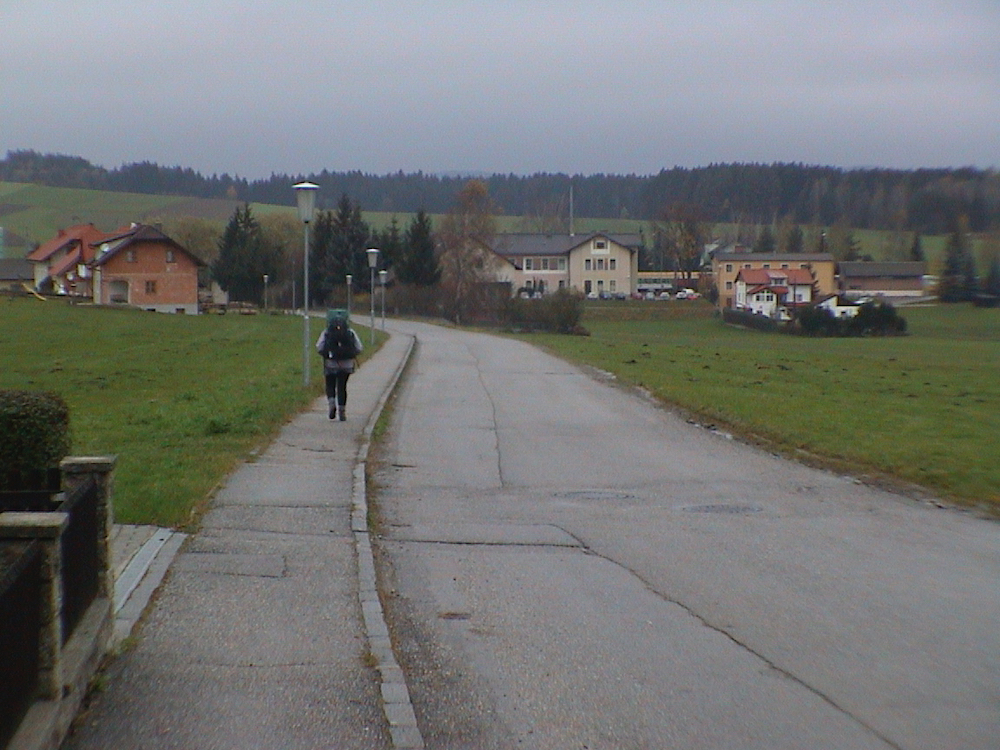
A direct train to Prague left Summerau at shortly before 9am on Wednesday. After a good breakfast, we said a German good-by to our fine Austrian hostess as we paid her. As we made our way back to the bahnhof, we admired the rolling green hills of the countryside we inhabited for one night.
-
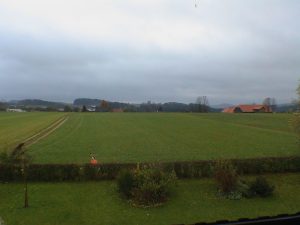
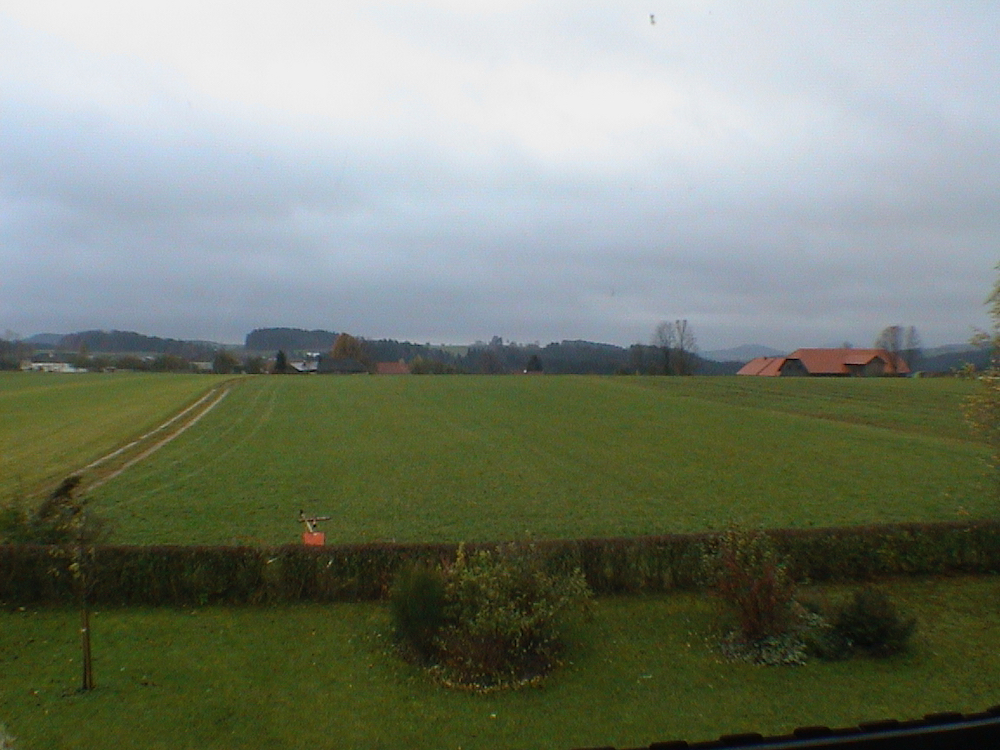
- We woke up to this view from our zimmer in Summerau, Austria
-
- Our train to Prague was waiting 500 meters away.
A Czech train was waiting for us, and we climbed aboard a second-class car… our passes don’t cover the Czech Republic, so we’ll buy our tickets as we go. Today we’re paying for cheaper seats.
Boarding this train felt like entering the third world. The seats of our compartment resemble the bench seats of American cars from the late 40’s. In fact, the entire car feels like it could have been built shortly after the second world war.
We found painted steel where we’d usually seen lamination, the doors are heavy and crude but rugged and functional, and the bathrooms resemble those found in remote parks in the north woods.
We’re told not to use the bathrooms while the train is at a station, because some toilets release their contents straight out the bottom of the train and onto the tracks. So it might be a Bad Idea to walk along railroad tracks in Eastern Europe.
Before the train started moving, we were greeted by many people wearing uniforms. First was our conductor: a tall, young guy with a pony tail who spoke enough English to sell us our tickets. We were charged 120 schillings (about $40) for both of us to make the 4-hour trip to Prague. We had 150 schillings, and he gave us our change in Czech koruny.
Next came a couple of guys asking us for our passports, which they stamped and handed back to us. Obbie said, “dekuji,” (Czech for “thank you”) to which they responded, “What you say?” We hadn’t checked the uniforms closely enough. These were Austrians checking us on our way out. “Uh, danke,” we responded with a good-natured acknowledgement.
The Czechs came through shortly later. The passport officer was accompanied by a customs officer. It was the first time we were asked, “do you have anything to declare? … cigarettes? … alcohol?” We did not, so the friendly young lady moved on.
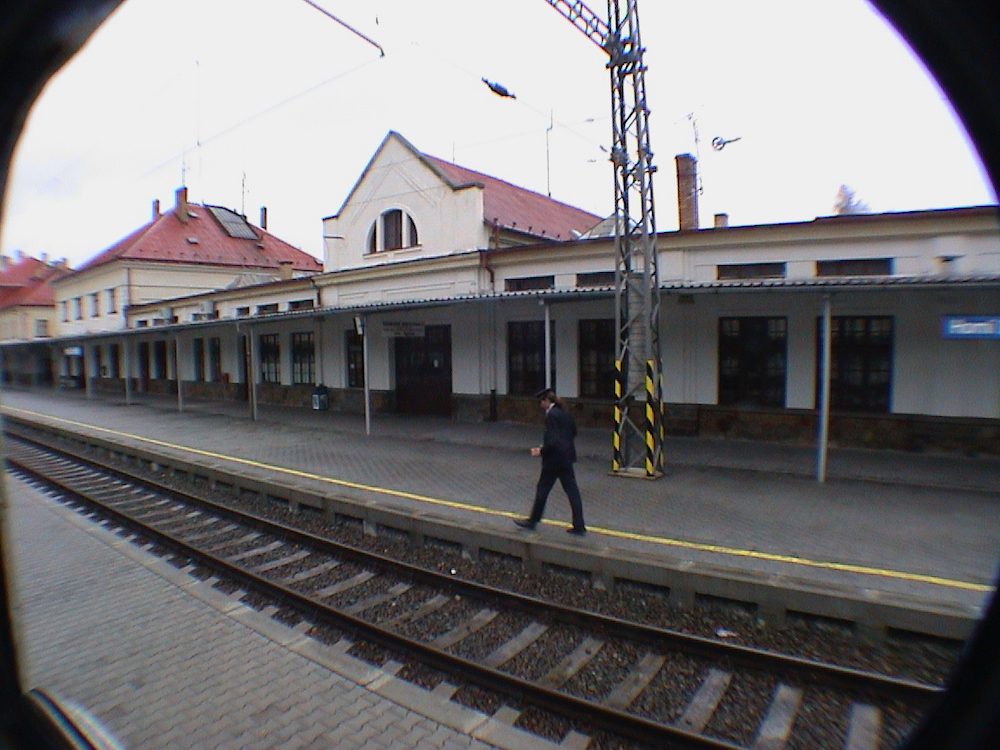
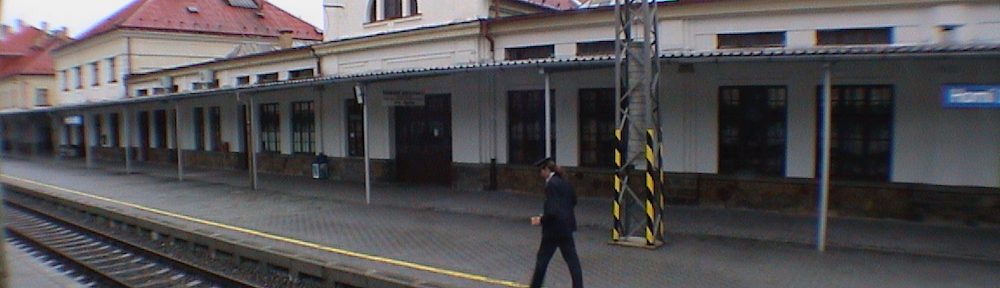
Our first conductor of the day walks along the platform at Ceske Budejovice.
We arrived in Prague in the early afternoon. At the first money-change window we found, we traded in our leftover schillings for some Czech koruny (crowns), and re-combobulated at a small cafe under the main dome of the old station.
The inside of the dome featured ornate sculpture-work, though the paint peeled in a few spots. It was a combination of elegance and worn antiquity.
We ordered orange juice and turkish coffee. The juice was actually quite good, and the coffee was thick… literally. In the bottoms of our small cups was about a half centimeter of coffee grounds. This coffee gave us a kick that the coffee from our Austrian guest house did not.
At the next table was a tall young thin guy who started up a conversation with us in broken English. His name is Michal, and we quickly built up a rapport. He went on to guide us around the station and helped us get settled into the city.
We wondered why he had warmed up to us so much, and we gradually deduced that we gave him a chance to practice his English, and that he had time to kill before taking his own trip to Berlin the following morning.
In Prague’s main train station there are nearly a dozen places to go to find accommodation. Most are brokers who take a small commission, but they save the hassle of schlepping your bags around town looking for a place on your own. They fill the roll served by the TI in most other cities.
Our reception in Prague is a refreshing change from Salzburg. Everyone we’ve met so far has been friendly enough. But then Obbie explained to the clerk at the TI that his grandmother was born in Ostrava; she broke out into gushing smiles and exclaimed, “So you are Czech!” It was as if to say, “Welcome home!”
People have been more than willing to help in spite of occasional language issues, and we’re feeling more at home every minute.
We’re set up with a room in a private house 10 minutes away from the station by tram. For Kc1000/night (less than $30), we have a spacious room with hardwood floors, hardwood furniture and full use of the kitchen and a comfortable sitting room. Our window faces the street (and the river across the street), but there are double windows to keep the noise out. And there’s a tram stop outside the front door.
Our hostess’ name is Vera, a small woman about a generation older than us. She showered us with English-language guidebooks to Prague, which we will use to plan our walkabouts for the next few days. Michal came along with us to Vera’s place while we got set up. Free of the weight of our packs, we set out to see what we could in the remaining daylight.
Like all good tourists we went straight for Karluv Most (Charles Bridge). This bridge is over 500 years old, and in its day three lines of carriages could pass across its cobblestone surface. There are old sculptures in its many alcoves, and on one end of the bridge a 12-century entry tower still remains.
We walked through a neighborhood full of embassies and assorted government buildings to the foot of a walkway leading up the hill to Prazky Hrad (Prague Castle). The walkway is an arts and crafts fair, and much of the work displayed in the small stands was quite beautiful.
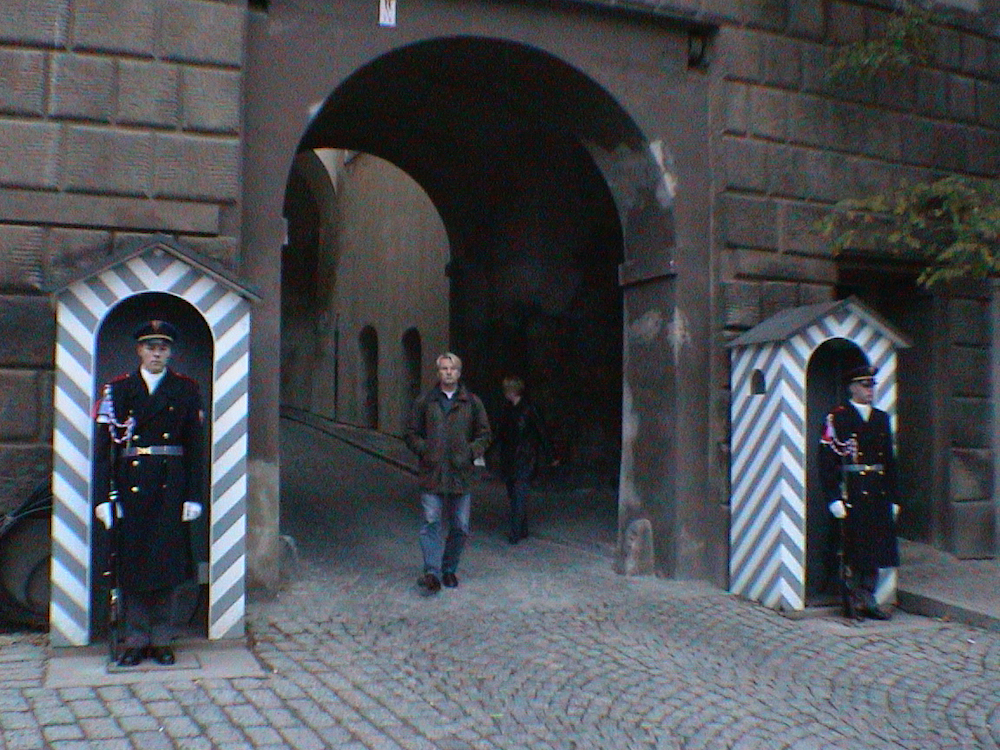
Today we’re only going as far as the castle entrance. The entrance is flanked by two little guardhouses, where uniformed guards stand at attention for two-hour shifts before another pair march out for a ritualistic changing of the guard.
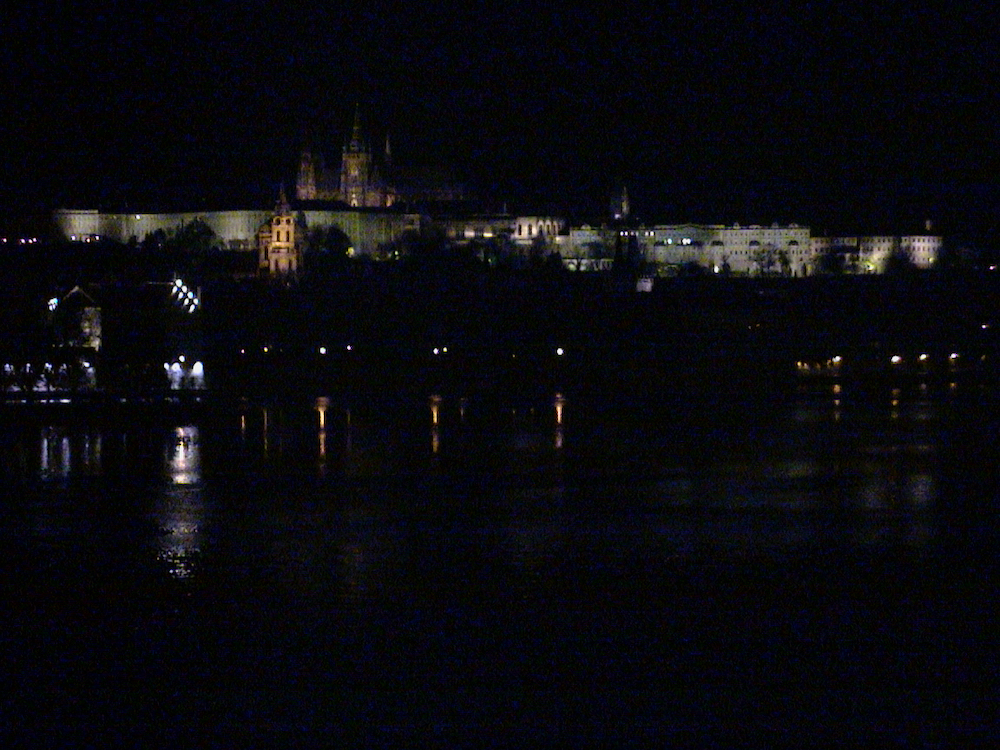
We shot some pictures from this spot as darkness fell, then went back across the river in search of food and drink.
-
- The western end of the Charles Bridge in Prague.
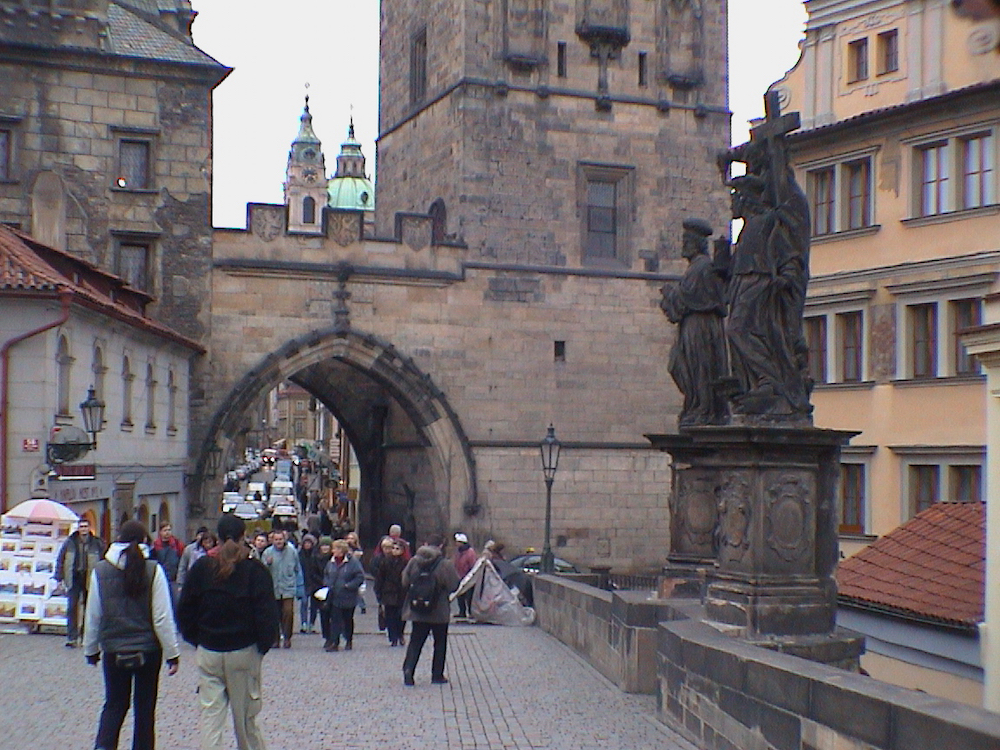
-
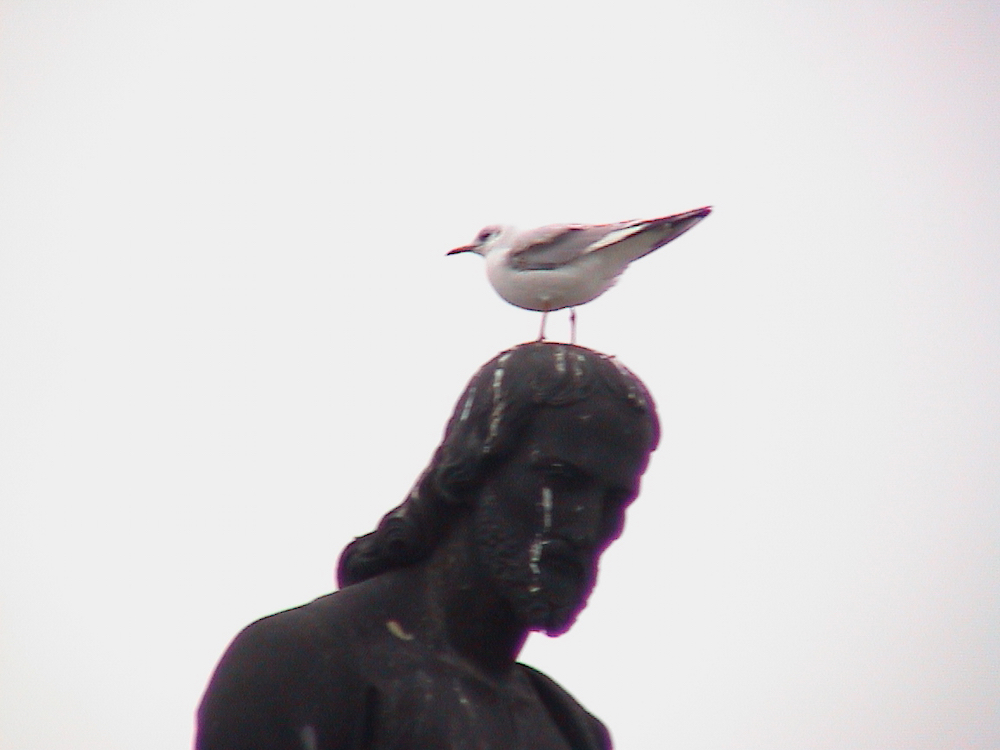
- This sculpture in an alcove of the Charles Bridge has a name that’s unknown to us, so we called it “Birdshit Jesus”.
-
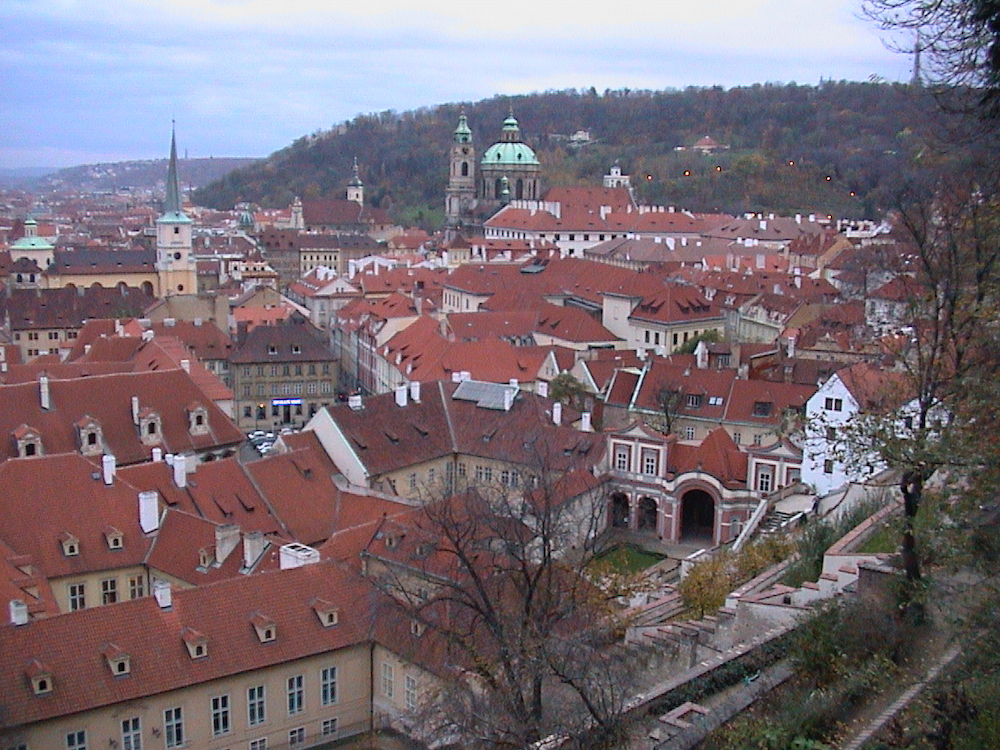
- From near the east entrance to Prague Castle we could look out over the rooftops of Mala Strana.
-
- The gates to Prague Castle are guarded by sentries.
-
- A view of the Vltava river and Prague Castle after dark.
Michal was so helpful as our guide and interpreter that we wanted to buy him dinner, and he recommended a tavern in the old part of the city (Stare Mesto). It’s a place that serves one of his favorite beers: Budweiser. This is not the American beer with the same name (which he regarded as urinal water, an assessment we agree with), but a fine pilsner from the Czech city of Budvar. The name was stolen and desecrated by the brewery from St. Louis, and the American product is not sold in the Czech Republic.
Obbie was eager to sample a traditional Czech specialty that was served by his grandmother, and later by his mother: potato dumplings. We each feasted on huge plates of traditional Czech food (including potato dumplings – not quite like grandma’s, but close enough) and pints of Budvar Budweiser. In the end, this spread for three people cost Kc500 – less than $15.
We understand why so many American expats live in Prague. The dollar is worth Kc37. When you do the arithmetic on prices, everything is ridiculously cheap. A kid with a modest trust fund could milk it along for most of his/her life living in the Czech Republic.