Prague had been good to us, and we didn’t want to leave, but we had another reason to be in the Czech Republic. Four hours east is the city of Ostrava, which is the birthplace of Obbie’s grandmother. Her birth certificate lists her birthplace as Vitkovice, which is now a neighborhood of Ostrava. So today we’re on a train to the Ostrava-Vitkovice station.
Along the way, we saw a lot of fields with rows of structures resembling utility poles. But the poles looked too tall for the length of the cross arms. We were seeing hops fields, and the hops had already been harvested.
On a four-hour train trip, we didn’t see a single cow. Either the Czechs aren’t allowing their cows to go outside, or they’re getting their milk from somewhere else.
At the Vitkovice station, there was no TI to be found. An agent at the station recommended that we inquire at the Hotel Atom a few blocks away. While Rozie researched the quality of local toilet facilities, Obbie studied a street map of this part of the city that he found on the front wall of the station.
On the map, he spotted the location of Sv. Pavla – the church where his grandmother was baptized – and vocally expressed his delight. This aroused the curiosity of some passers-by, one of whom was a guy about our age named Vaclav.
Frequently consulting his dictionary for the right words, Obbie told Vaclav that he was looking for Vitkovice’s Catholic Cemetery (where a set of great-great-grandparents is supposed to be buried). Vaclav pointed south from the station, saying, “tu! tu!” By this time Rozie had returned, and Vaclav led us down the sidewalk. We knew he was leading us someplace, though we weren’t sure where. This was just another part of our adventure.
Vaclav was taking us to the cemetery, which was literally across the road from the train station. The office was closed, so there was no one there to look up where the ancestors’ graves might be. We can come back on Monday.
The Hotel Atom is a four-star place about a half-mile down the road. Vaclav bought us tram tickets and took us there. Obbie asked the woman at the front desk, “mluvite anglicky?” and she said, “yes.”
We started to explain our situation… no TI, and we’re looking for low-cost accommodation. Out of curiosity, “How much is it to stay here?” “One thousand five hundred crowns.” The room rate was less than $50 including breakfast, so we found no reason to leave the comfort of an English-speaking staff just to save a few bucks.
We bought dinner for Vaclav and exchanged addresses; and as we parted company we delivered a warm expression of gratitude by way of the desk clerk who acted as a translator.
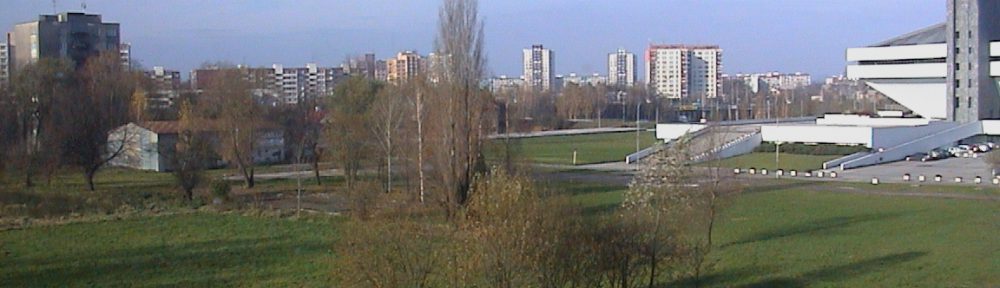
The area around the hotel is a sprawling complex of grey high-rise apartment buildings … purely functional, with no aesthetic form whatsoever. We’ve started to call them “commie high-rises.”
The hotel itself was a repurposed commie high-rise on the outside. But on the inside it had nice carpeting, a sculpture of a naked lady in the hallway, and a friendly staff that knew just enough English.
Ostrava is a shabby place where almost nobody speaks English. The little bits of Czech that Obbie managed to learn came in very handy. In this part of the country, the second language for anyone over the age of 30 is German. It seems that the schools started teaching English after the fall of communism. So younger people are exposed to English, but they have little experience with it relative to their peers in Prague.
This side trip is demonstrating how Prague is the showcase that the Czech Republic displays to the world. If you leave Prague (or even venture onto the un-touristed back streets of Prague), you can see the legacy of the many years of life under oppressive regimes.
Much of the country is still kind of beaten up, but it’s working hard to clean up and rebuild.