Today we’re taking a day trip to the little town of Dobra in search of a marker for the other set of great-great-grandparents. The train that takes us there leaves from a small station across town, not from the Vitkovice station where we arrived yesterday.
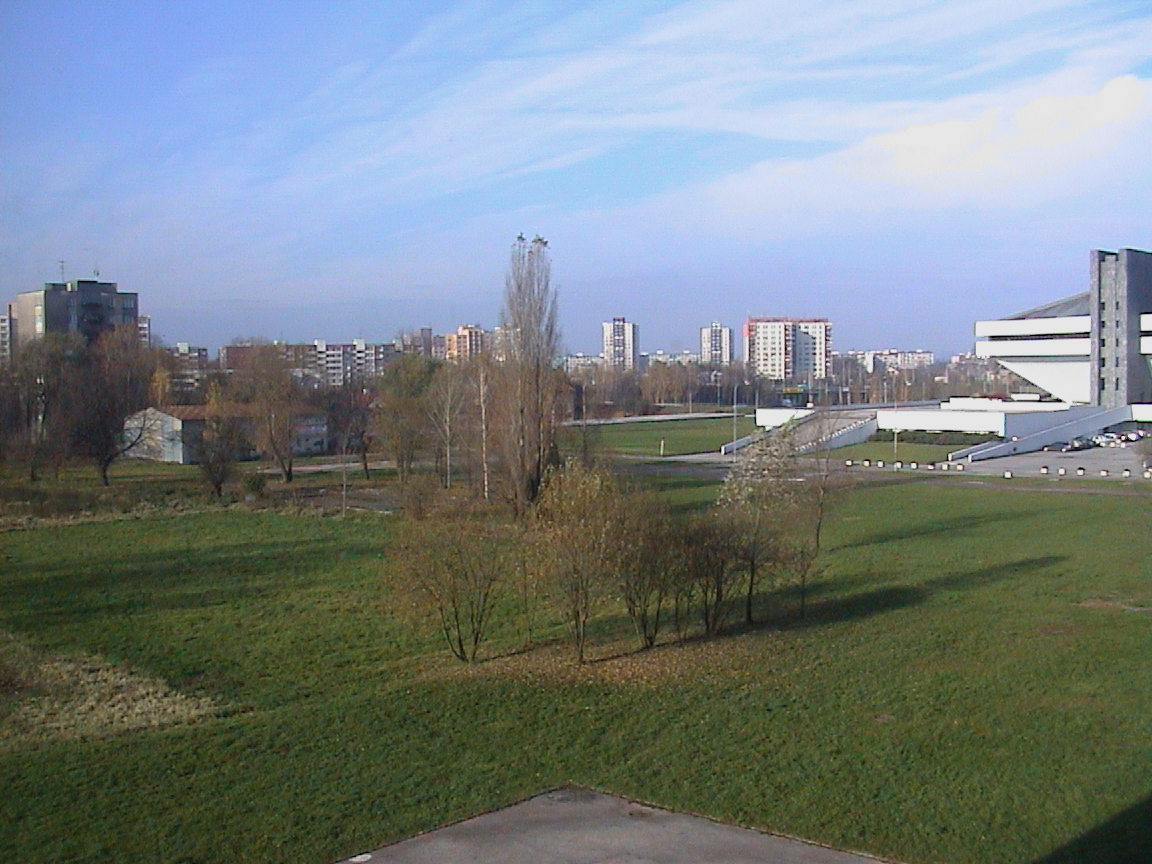
This part of Vitkovice is dominated by minimalist apartment blocks we call “commie highrises.” One advantage to this type of urban design is that it offers a lot of shared green space without giving up density.
This is an area suffering from some serious poverty. In spite of the poverty that plagues the Ostrava region, they can still afford a cheap and reliable tram system. It proves that a city does not have to be rich or large (Ostrava has 200,000 at the most) to support such a system.
The tram let us off at a bus station. A freeway separated us from the train station, and by the time we figured out how to cross it, we’d missed our train. But this is Europe, and another train will be here in an hour.
At the newsstand we bought a copy of The Guardian (one of our favorite English-language newspapers is available in this far-flung outpost of the eastern Czech Republic!) to read while we waited.
A little old lady walking across the platform called out to us to ask something in Czech. Obbie replied, “nerozumím moc cesky” (I don’t understand much Czech). The woman perked up a bit and said, “Kde jdete?” Obbie thought, “hey, I understand that! ‘Where are you going?'” He replied, “Frydek-Mistek.”
As the woman walked away muttering in disgust, Obbie remembered that “Kde jdete” also means, “where do you come from?” So a linguistic goof sabotaged a potential memorable interaction.
Our train resembled some of the two-level German commuter trains we’d seen, except that this train was diesel-powered and looked a lot more old and ragged. Out the window we could see the back yards of middle-class neighborhoods, where everyone had gardens, most people had chickens, and many people had goats.
In Frydek-Mistek we stepped directly from our train onto another train that would take us to Dobra in five minutes. After passing a landscape of rolling hills sprinkled with commie high-rises we came to a small deserted station.
We didn’t need a map to find the church. The town is small enough that when we looked around we could see the steeple. We found the church that part of the ancestral family attended, but there was no cemetery there. We inquired at the rectory, but all we could understand was that it was 2km down the road. We started walking.
After asking for directions in Czech two more times along the way, we finally got to the cemetery. It’s Sunday, so the office is closed which means we’re on our own to find ancestral resting places.
We met a couple of ladies who knew enough English to direct us to an older part of the cemetery, and they explained to us how European cemeteries work. Unlike the sprawling graveyards Americans are familiar with, Europeans arrange their plots in tightly-packed rows. Plots are about the width of two queen-sized beds, and each plot bears a marker for a family and a list of the family members present in this grave.
A fee of some sort (rent?) is paid every ten years by the family holding the plot. If the fee is not paid, the plot is given to someone else. Our language skills did not permit us to ask the obvious delicate questions on this practice.