
Today, we’re taking a morning train to Berlin, so we get to look at another region of the Czech Republic.
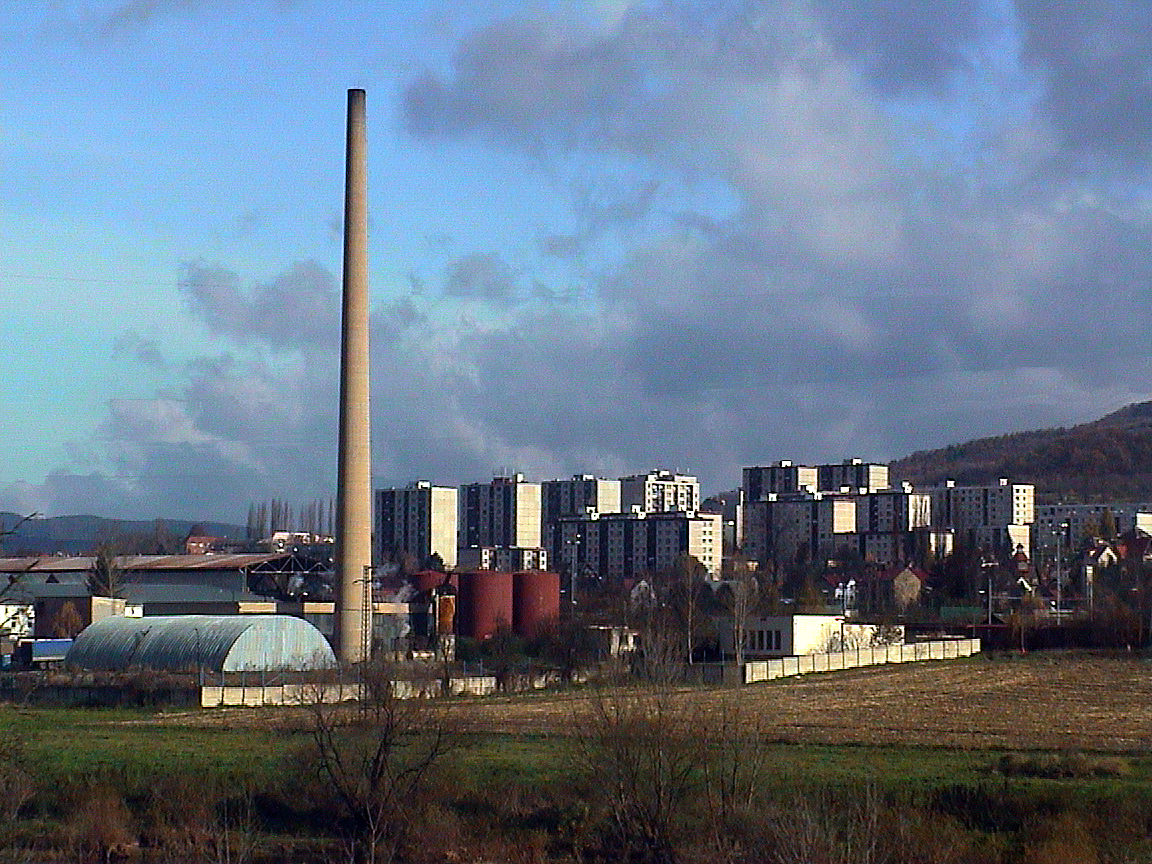
A town seen in the Labe Valley that’s typical of communist era design… A central factory, surrounded by “commie high-rises” to house the workers.
Early on, a group of people got onto our car speaking a language that sounded a lot more like Mexican Spanish than Czech. It didn’t take long to recognize that it was Spanish. This is a family from Monterrey, Mexico. A young man in his 30’s was taking his wife and his parents on a tour of Europe.
We reached the German border shortly before reaching Dresden. We knew we were in Germany when we saw a cow. We never saw cows anywhere in the Czech Republic.
At the border, the Czechs and then the Germans came through to do passport and customs checks. We heard a lot of questions being asked of the Mexicans as forms were being filled out. Our passports got glanced at and handed back.
After it was all over, Obbie walked through the car asking (in his dodgy high school Spanish), “why so many questions for the Mexicans but not for the Americans?” That drew a chuckle from the patriarch of the Mexican group (who did NOT speak English as his son did). The Mexicans told us it had to do with a lot of shopping they had done in the Czech Republic, so they didn’t have any reason to see it as such a big deal.
Except for the station, the entire city of Dresden as seen through the train window looked as if it had been built in the early 50’s … and mostly it had. The beautiful old buildings destroyed by allied bombing had been replaced by simple grey boxes … commie high-rises, commie office buildings … all function, no form. Such a shame.
Someone joined the train in Dresden to demonstrate that German firmness and rigidity were alive and well. We had a pair of reserved seats, but we preferred the empty seats across the aisle with a power outlet nearby (didn’t want to burn up the batteries of our electronic gadgets if we didn’t have to). The Mexicans were sitting in our seats, and we didn’t mind.
A woman stepped into our train car, gave us a ghastly look, pointed to our seats and yelled, “Platz!” Tempted to jump into a Nazi salute in response, all we could do was to look around at a coach car filled with empty seats. Other than us and the Mexicans, she was the only other person on the car. There may have been 90 empty seats, but we were sitting in HERS. Eventually she chilled out and went to sleep in the seat behind us.
When we got to Berlin Ostbahnhof (East Station), we had a hard time grappling with the layout of the place.
Many European train stations – including this one – are much like American shopping malls. There are dozens of platforms, and the corridors between them are lined with shops of all kinds. Mixed in with the “shops” are ticket agents, banks, money changers, hotel reservation agencies, and other train station stuff.
But these sprawling complexes do not usually come with the kiosk-mounted maps common in American shopping malls. This makes it hard to find what you’re looking for, or even to figure out where you are.
Eventually we found an information counter and got a local street map. We started studying the map to figure out east from west (train travel can disorient your sense of direction), and how to get to our hostel.
A young man in a blue jacket approached and asked if we needed help. His jacket bore a logo that read “Bahnhof Mission.” As he guided us to the platform for the S-bahn that would take us to our hostel, he explained that it was his job to help disoriented and confused travelers (Bahnhof Mission is part of Travelers’ Aid). We completely matched the profile he’d been trained to watch for: rucksacks, looking at a map, etc. He taught us how to buy tickets and use the S-bahn before we thanked him kindly and went on our way.
The Sunflower Hostel was close enough to the Bahnhof that we could have walked there had we been a bit more stingy. But one’s willingness to spend money on transport increases with the weight of the load on the back. We booked a private room with a double bed for about $50/night including breakfast.
We had a rough start in Berlin. Somewhere between the S-bahn and the hostel, Obbie stepped in a steaming heap of dog shit, so a lot of time was lost on the disgusting chore of cleaning big-city residue from the crevices of his hiking boot.
Our plan for tonight is mostly to hunker down and rest, which includes a badly-needed round of laundry. Laundry in Europe is slow and expensive. It typically takes about $5 and two or more hours to convert a load of dirty laundry into a pile of clean, dry clothes. Most of the machines seem to be built to sacrifice speed for conservation of water and energy. As long as you’re prepared for laundry to take three hours instead of one, this is no big deal.
After starting our laundry, we found out that our room is in a wing where the heat’s on the fritz, so we have to move up a floor if we want to stay warm overnight. Before moving, our cold room gave us a great vantage point to watch a very colorful sunset, and to listen to the sounds of the city, including the clatter of S-bahns and InterCity trains moving back and forth.
The Sunflower Hostel is a place that goes out of its way to cater to English-speaking clientele. Most of the in-house signage is in English and the staff are reasonably fluent. They have plenty of those glossy little brochures on the local sights and club scene, and they were all in English. Sometimes we found amusing instances of messed-up translation, but the intended message always got through.
While waiting for our laundry, we walked around the neighborhood to find something to eat. We are in what was once communist East Berlin, and the main drag still looks like a show-case of grand Marxist ambition. But it feels empty, the kind of emptiness that presents an opportunity for repurposing and repopulating by adventurous and enterprising anarchists and hipsters.
Our biggest problem with Berlin and this part of Germany so far… people smoke, and they smoke a lot. Outdoors, indoors, in small poorly-ventilated cafes, cigarettes fill the space with smoke. No matter how clean or dirty the outdoor air may be, the indoor air is suffocating.