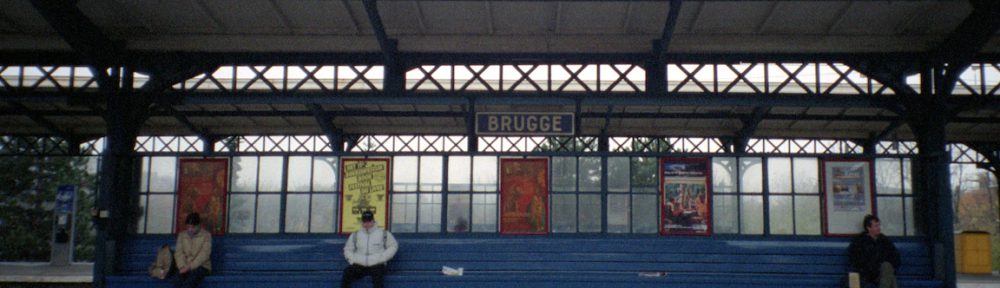
Our Thursday morning begins at the Bruges station shortly at 9am. We need to catch a train to Brussels to connect with the Eurostar to London.
-
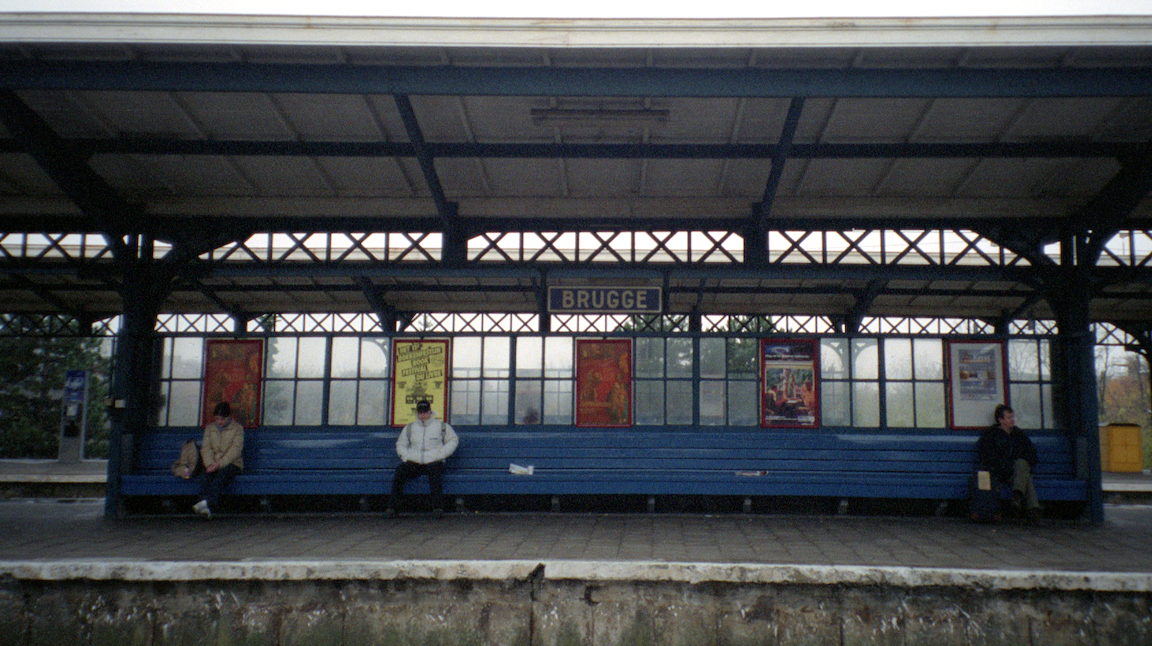
- The platform of the station in Bruges.
-
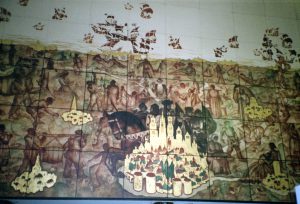
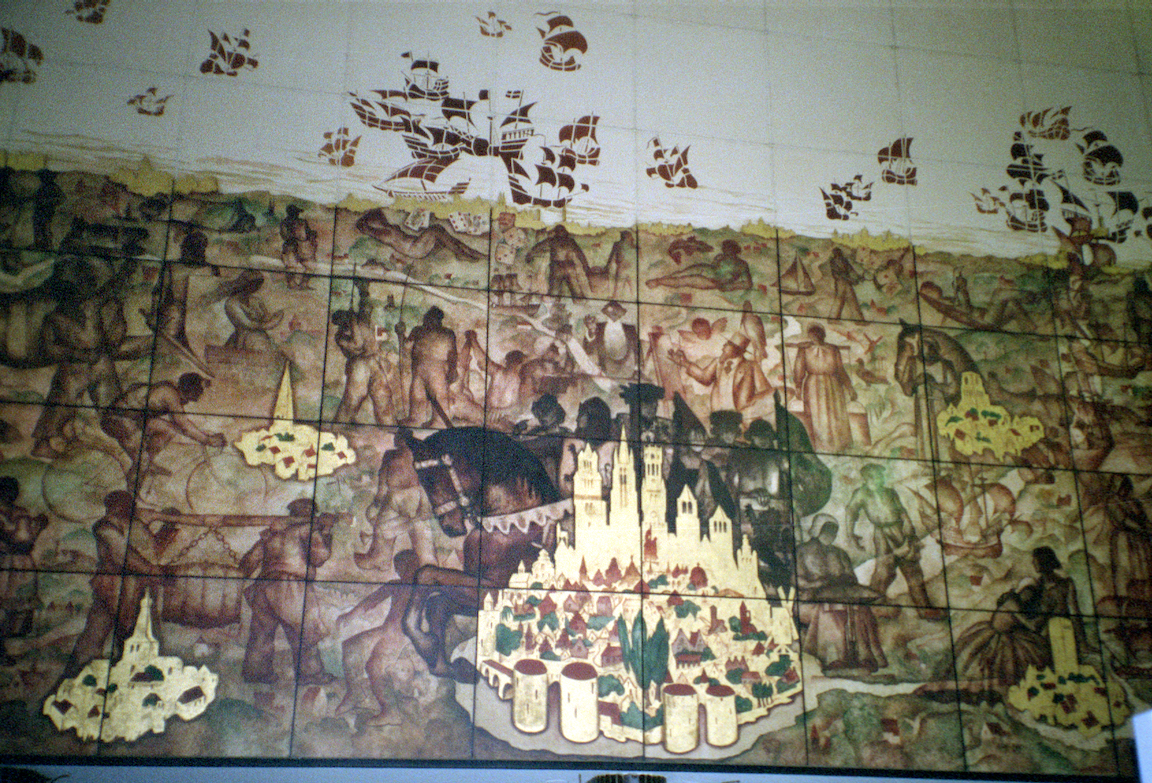
- One of the murals on the interior of the Bruges train station.
Eurostar is to intercity rail what the Concorde is to air travel: fast and expensive. From either Brussels or Paris, you can get to London Waterloo Station in about three hours. Once the Brits finish building the high-speed track on their side of “The Chunnel,” another half hour will be shaved from the travel time.
Our rail passes entitle us to a discount, but we still have to fork over nearly $100 in reservation fees and supplemental fares between us.
The marketing for Eurostar talks a lot about being faster downtown-to-downtown than flying, and they’re right. They suggest riding Eurostar to avoid the “airport experience.”
What they don’t tell you is that Eurostar brings the airport experience to the train station. Run your bags through x-ray machines, walk through metal detectors, show your passport a few times, and you’ll eventually be deemed worthy of a seat in the departure lounge.
We can see the train waiting on the platform, but it won’t be boarded until about five minutes before departure. So even though we were told to be at the station a half-hour early, they kept us in the departure lounge for 20 minutes. There were still more security checkpoints on our way to the train.
Other than being fast (about 180 mph), the Eurostar is nothing special. Why do “elite” high-speed trains always have to be so cramped and uncomfortable?
The Channel crossing took about 20 minutes, which went by quickly. Our ears popped a bit as we descended into the bowels of the Earth, and a funky electrical smell lingered in the bottom of the tunnel. Overall, it felt no different than riding the BART between San Francisco and Oakland, or any train going between New York City and New Jersey.
Once we got to London, we were greeted by a smiling old gentleman at Passport Control, who asked us a lot of questions before eventually stamping our passports and letting us back into the country.
First stop: the money changer. We still had about 1000 Belgian francs, which became about 14 pounds. Once we got £100 from an ATM, we had plenty of local money.
We can’t make a phone call with folding money. We need coffee. Recharging our caffeine levels left us enough change to use the phone. We called Jen & Gabe and let them know we’re close.
We bought tube tickets and descended into the labyrinth of the London Underground system. We never did get outside the station.
A short time later we were at the Bethnal Green station. One more phone call will summon our ride. We tried four phone boxes before finding one that worked.
We were instructed to stand under a nearby railroad bridge and wait. We were there for ten minutes, which is a long time when you’re standing still with a huge load strapped to your back.
Gabe showed up in an old Austin Mini, which he described as England’s answer to the Volkswagen Bug. A VW is cavernous relative to this Austin. Somehow, we managed to get both of our bodies and packs into the tiny thing. Fortunately, we only had to go about a mile.
When we got to Jen & Gabe’s apartment, the four of us had a lot to talk about. Jen wanted to be briefed on her brother’s Thanksgiving dinner. We were carrying the wishbone from that dinner’s turkey, which we delivered to Jen on Bobber’s behalf.
We carried on about the wonderful discoveries we are all making as Americans in Europe, and how our country looks different when you’re on the outside looking in.
Afternoon transitioned to evening, and the topic of conversation turned to food. Jen observed that this is our last night in Europe, so we might want to do something special. Dinner at a nearby Chinese noodle place sounded special enough for us.
It took 15 minutes to get there on an old “double-decker” bus. The four of us sat in the front of the upper level and watched the neighborhood pass by below us.
This bus has a driver and a conductor. After you board the bus and find a seat, the conductor will catch up with you to collect your fare (usually 70p). Hang on tight in the upper level, because when the bus turns hard or hits a bump, the swaying is much more pronounced.
Once we were well fed and back at the apartment, it was time to repack for the airplane trip. That means separating our carry-on stuff from the stuff that can ride in checked luggage.
Since we last flew in late September, 40 rolls of film and 25 hours of video tape have been added to our carry-on load. Once our carry-on bag was assembled, we had to pack everything in a way that would enable the carry-on bag to travel inside of the main pack on our morning tube/train ride to the airport.
So after two months in Europe, this is how we spent our last night: Eating Chinese noodles and repacking.